

What makes Alaska, Alaska
Apr 17, 2026
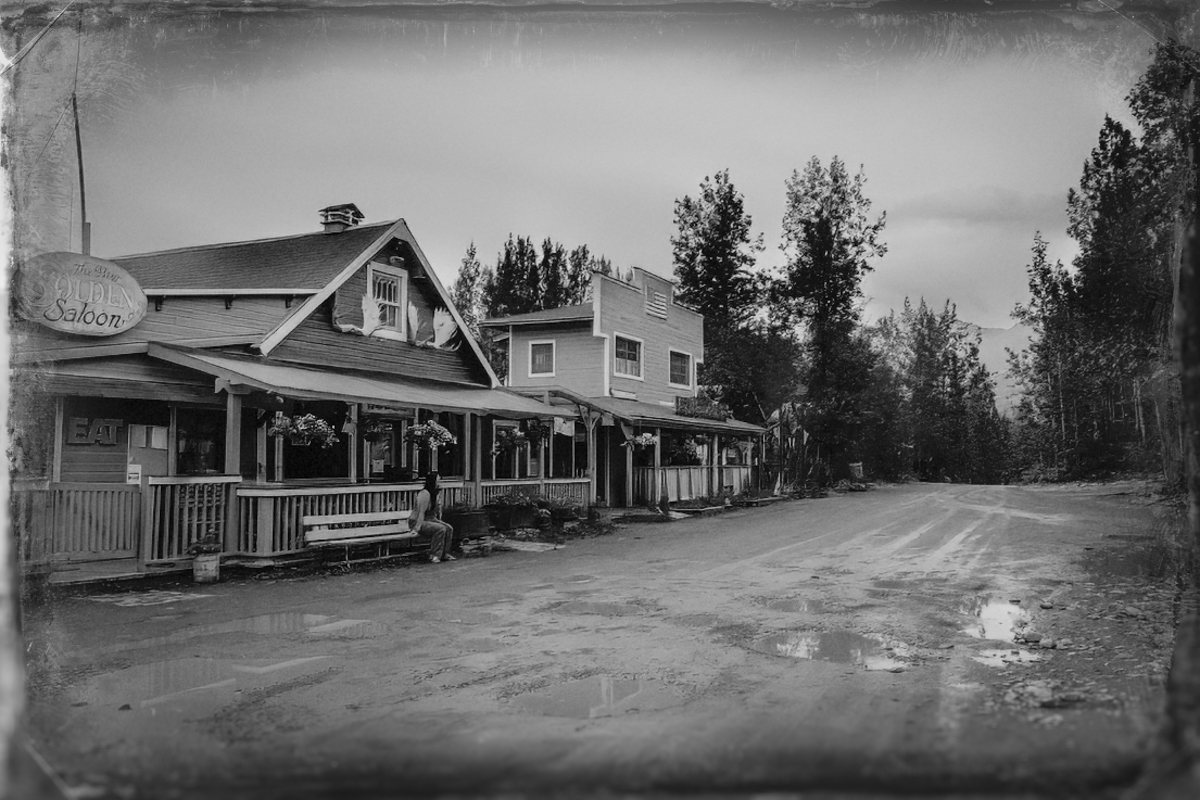
McCarthy, Alaska began as a rough-and-ready supply and recreation town for the nearby Kennecott copper mines in the early 1900s. Connected to the outside world by rail, it bustled with miners, merchants, and frontier life until the mines closed in 1938, leaving it nearly abandoned. Decades later, McCarthy was reborn as a remote, off‑grid community and gateway to Wrangell–St. Elias National Park, preserving the spirit of Alaska’s wild mining past.
If the land is the body of Alaska, the weather is its mood.
Here, weather isn’t small talk—it’s a relationship. Storms arrive with presence. Wind on a ridgeline reminds you that a misstep has consequences. Clear skies can turn to fog faster than your coffee cools. As a photographer, that uncertainty keeps me awake to impermanence. The same mountain can be brutal in cutting wind, tender in alpenglow, mysterious in snowfall, or invisible in cloud. That shifting face of the land mirrors my own inner weather. Alaska taught me that storms pass, light returns, and even harsh moods have their place in the story.
Another thing that makes Alaska, Alaska, is that you are never truly alone. Even when you see no one for miles, you feel eyes on you: ravens overhead, a moose in the willows, an eagle riding a thermal, a fox jumping in front of you. This isn’t a human-designed landscape where animals are decoration. It’s their home. We are the visitors.
That truth shapes my work. I’m not “capturing wildlife”; I’m stepping into someone else’s living room. So I wait. I stay quiet. Many days, all I bring home is a set of tracks in the snow or a distant silhouette. When a real moment arrives—the gaze of a fox, a moose pausing on the trail, a dog leaning into a human hand—I feel not conquest, but responsibility. These are not props. They are sentient beings with their own stories. Every photograph is a promise to honor that, and to use their image in service of a world where they still have a place.
Alaska is often marketed as “untouched wilderness.” That story erases the people who have lived here for thousands of years. What truly makes Alaska, Alaska, is the deep relationship Indigenous peoples have with this land—built on respect, reciprocity, and an understanding that the land is a relative, not a backdrop.
I’m not Indigenous, and I don’t speak for those communities. But living here, you can’t ignore that their languages, stories, and knowledge are braided into the rivers and mountains I photograph. That awareness shifted how I see my work. I no longer think of my images as isolated achievements, but as brief contributions to a much longer conversation—one that began long before me and will continue long after I’m gone.
You also can’t talk about what makes Alaska, Alaska without talking about light.
In summer, days stretch into a soft, glowing continuum. For a photographer, it’s a dream: hours of low, molten light sliding across peaks and rivers. But endless light erodes boundaries—you keep hiking, shooting, driving, as if the day will never end.
Then winter swings the pendulum back. Short days. Long nights. Light that arrives late, leaves early, and sometimes never reaches “bright.” I won’t romanticize it; the darkness can be heavy. But it has given me something unexpected: the ability to sit with my own shadows without turning away. In that stripped-down season—snow, bare branches, muted skies—my images grow quieter, more introspective. A single shaft of light across a frozen river can move me more than the loudest summer sunset. Alaska taught me that not all beauty is loud. Some of it whispers
If I tried to sum up what makes Alaska, Alaska in a single sentence, I’d fail. It’s too vast, too contradictory. But I can say what it has done to me.
It took someone who had seen too much of the worst in people and reintroduced him to the best in the more-than-human world: a spruce bent by snow but still standing, a dog racing along a riverbank, a moose standing knee-deep in willows at sunrise.
This place taught me to see beauty not as an escape from reality, but as proof of what is still worth defending. When I feel the wind push against my chest on a ridge, when I watch a dog glance back at their person with absolute trust, when I frame a distant glacier through the trees, something in me aligns.
Alaska holds all of that: the land, the light, the animals, the people, the history, the grief, and the hope. It isn’t a backdrop to my life. It is an active participant in it—a different reality built on mountains, rivers, caribou trails, and the slow wisdom of spruce trees.