

Dancing on the Edge: The Day the Glacier Almost Took Me
Mar 13, 2026
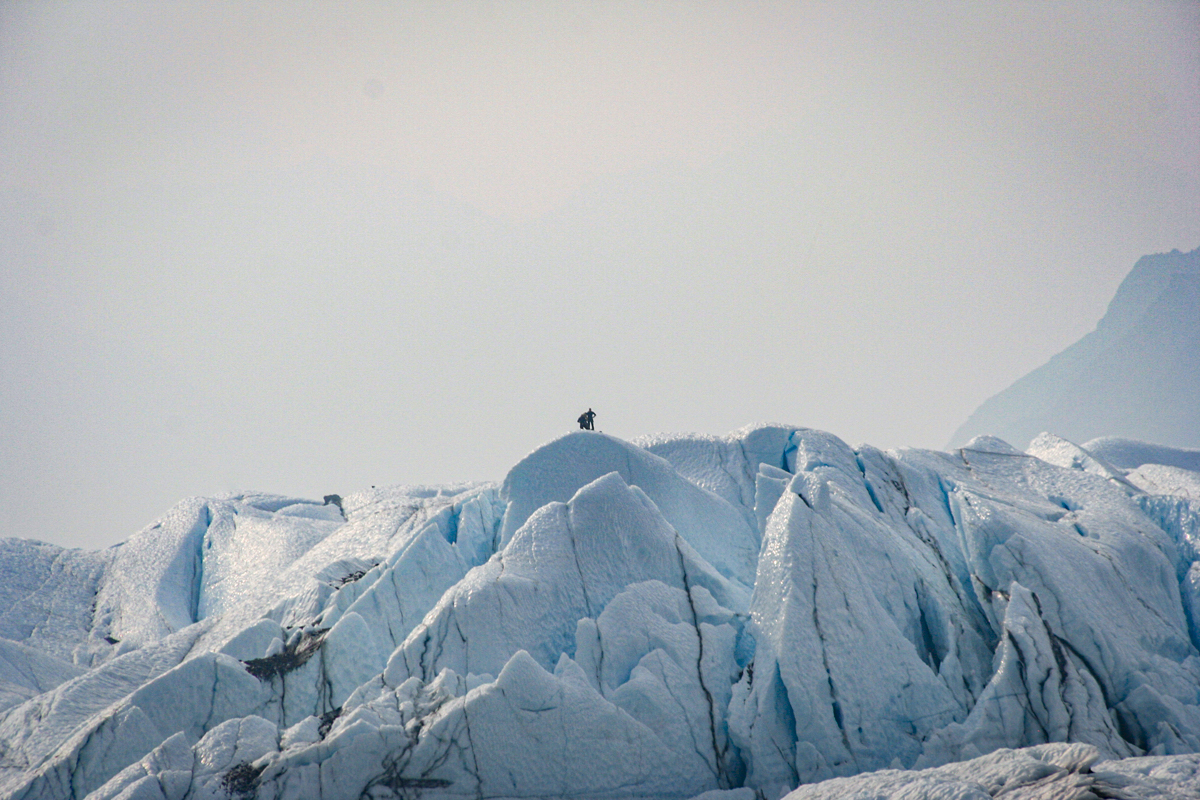
The Matanuska Glacier is a massive valley glacier located about 100 miles northeast of Anchorage in south-central Alaska. Stretching roughly 27 miles long and 4 miles wide, it is one of the largest glaciers in the United States that can be reached by car. Visitors can walk on its blue ice, explore crevasses and ice formations, and experience the powerful, ever-changing landscape shaped by thousands of years of moving ice.
Along with a client/friend and her family, we had hiked some distance into Alaska’s Matanuska Glacier. Our purpose was to capture a unique environmental portrait for her son’s high school senior yearbook. Leaving the group slightly behind, I decided to venture off the designated path, in search of the perfect composition for a ‘Hero’ shot of her son a this magnificent glacier. The air was crips and sharp, the silence immense, broken only by our conversation. Before I ever moved to Alaska, I was a top camping specialist at REI; teaching others how to prepare for the backcountry, how to pack, plan, and stay safe. I prided myself on my knowledge and my gear. I’d spent considerable time and effort learning to read the land, how to access ice travel and avalanche danger, and to move with respect and caution. If anyone was ready for the Alaskan bush, I thought it was me.
But on this day, I prioritized ‘getting the shot’ over thinking of safety. I forgot that glaciers are living things—always changing, always unpredictable. As I stepped off a ledge, I misjudged a patch of ice that looked solid. One step, and the world gave way beneath me. In an instant, I was plunged deep into freezing water, swallowed by the glacier’s hidden crevasse. The shock was total; ice water clawing at my skin, the light above shrinking, as I instinctively gasped out all my air while still underwater (I recalled learning about this immediate involuntary response, which has been termed the inspiratory or 'gasp' reflex. This respiratory response has been implicated as a contributing factor to cold water immersion drowning because of the urge to immediately take a deep breath while still submerged). Luckily, I had the insight to hold my breath.
I kicked my way up along the slick, 90 degree ledge of ice. My hands, numb and fingers stiff, I could only grip the edge to keep my head above the water. It was clear to me that I would not be able haul myself out. For a moment, I lay there, shivering, staring up at the sky, too confused to call out for help and utterly humbled.
All my friends saw was that I had suddenly disappeared and began to search. Fortunately, one of them saw my hands on the edge of the ice slab and they came to aid. As they came running toward me, I yelled out for them to approach carefully, so that they too did not fall through the ice. With their careful help, we were able to collectively pull me out. If I’d panicked, if I had been alone, I would have died that day.
The wild doesn’t care about your plans or your passion. It demands respect, humility, and preparation. That experience changed me. It deepened my reverence for these landscapes and the risks often taken to capture their beauty. It reminded me that every photograph is a gift, not a guarantee. And it reinforced my commitment to sharing not just the splendor of Alaska, but the reality of its dangers, and the urgent need to protect these places.
When you see my images of glaciers, nature, or wildlife, know that they’re more than pretty pictures. They’re meditations on fragility; of the land, of life, of the moments we’re given. I hope they inspire you to cherish the wild, to tread lightly, and to remember that every adventure is a dance on the edge.
Stay wild, stay safe, and never stop seeking wonder.